



































Justice at the Crossroads: Will the POSH Act Finally Protect Women Lawyers?
The Supreme Court makes a significant move regarding the POSH Act's applicability to women lawyers, which can be read as a strong inquiry about safety in the workplace in the legal profession.


The matter gets to the Supreme Court
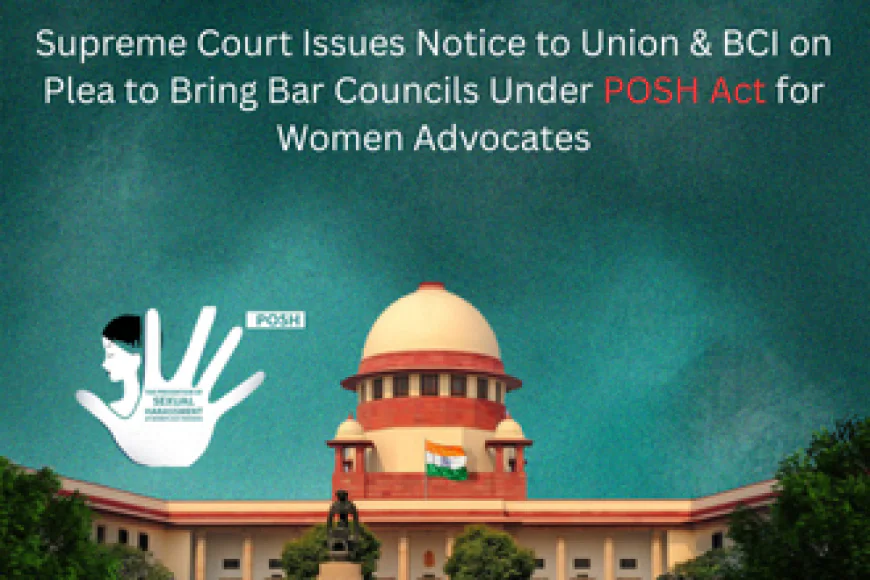
A very important legal controversy has been initiated by the Supreme Court of India deciding to send a notice to the Central Government and the Bar Council of India in response to a petition asking for POSH Act protection to women lawyers. The petition points out that the legal profession lacks a redressal system for sexual harassment complaints, which is a very disturbing problem that, unfortunately, has been going for quite a long time without being solved.
Reason for the importance
Women advocates, being the likes of the corporate or institutional employees, are not considered as having a traditional employer–employee relationship. Therefore, they are very often knocked out from filing complaints under the POSH Act. This loophole has kept women lawyers in large numbers without any solid means to get justice as well as to be assured of the privacy of the harassment complaint process.
Challenge to the Current Interpretation
One of the petition points is that professional areas like law offices, court premises and legal associations are places where one works and interacts with colleagues or fellow members, even if these places are short on formal employment structures. Both sides of the debate, i.e. activists and legal experts, assert that by disregarding this fact the argument against the POSH Act protection for women lawyers essentially defeats the very intention of the Act, which was to warrant safety for all female workers.
Main Points Raised
Bar councils lacking Internal Complaints Committees (ICCs).
● No formal confidential grievance procedure.
● No presence of POSH Act rules, timelines and protection mechanisms.
● The legal profession works in a murky area where it is very hard for harassment cases to see the light of day.
Women Lawyers Demand Accountability
Women legal practitioners want the POSH Act to be interpreted broadly so as to cover independent professionals such as advocates. They also point out that the first step of justice cannot be taking place in a court if, however, there is still injustice outside it. The petition additionally petitions for the legal institutions to have complaint mechanisms in place as well as compulsory sensitisation programmes.
Next Changes Possibility?
In case the Supreme Court hears this plea favorably, bar councils, as well as legal bodies, might be obliged to:
● Set up Internal Complaints Committees
● Introduce PPH-compliant rules
● Develop unidentifiable reporting systems
● Provide gender-sensitisation training to lawyers and staff
New Chapter's Beginning?
Such an issue could be a turning point in India. First and foremost, this is about individual protection but, at the same time, it is about setting a new standard for all professions, whose employees do not have employer-employee relationships. It might thus be the case that the legal system will have to face this very difficult question soon: Can justice be really said to exist if those who fight for it are unprotected?