






























India’s Automotive Exports Hit a New High, Rising 13% on the Back of Policy Push and Global Trust
India’s automotive story is shifting gears fast. Vehicle exports have surged 13 percent in 2025, powered by strong policy support, global demand, and rising trust in Indian manufacturing—marking a defining moment for the Make in India vision.

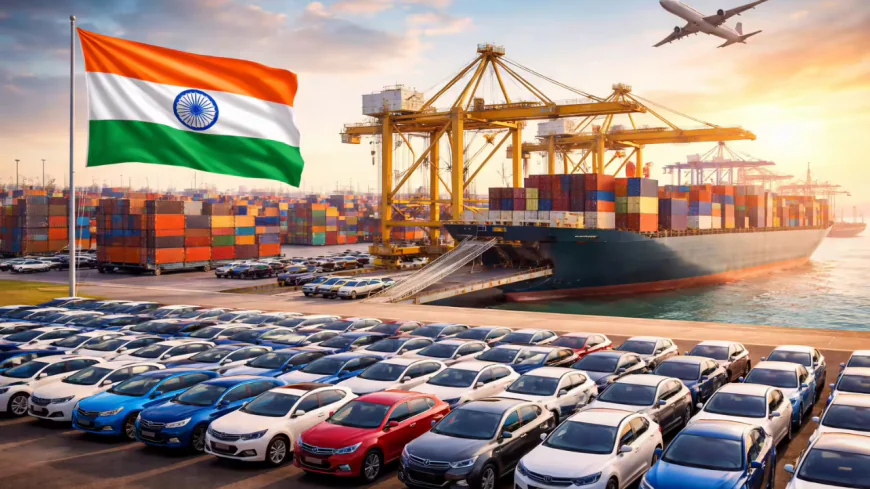
At a time when the rising industrial India is also gaining confidence on the global front, the automotive export of the country has suffered an outburst of 13 percent, which seems to be sending a very clear message, that, Make in India is not a mere slogan, but a reality of manufacturing across the world. As per the recent statistics published by Society of Indian Automobile Manufacturer (SIAM), vehicle exports in the first half of April to December 2025 increased to 6,70,930 units, compared to a sharp increase of 5,78,091 units in the same period in the previous year.
This is not an incremental growth but the transformative one. Maruti Suzuki India dominates this export wave with a 46 percent share of passenger vehicle exports followed by Hyundai Motor India, both of which underpins the reliable status of India as a reliable source of automobiles to the rest of the world.
The Growth Story: Confidence, Capacity, and Global Demand
What we are experiencing is not a temporary surge, but a paradigm shift in the perception of the Indian manufacturing by the world. Latin America, Africa, Middle East, and emergent Asian markets demand has been stable, although a number of economies have been experiencing uncertainty in the world. The Indian automakers have exploited this stability by providing cost effective, dependable and regulation compliant cars, which are geared towards various markets.
The power of India is its size and flexibility. Manufacturers are no longer exporting just entry-level cars; they are shipping feature-rich hatchbacks, compact SUVs, and now electric vehicles, reflecting rising global confidence in Indian engineering standards. Some of their models such as the Swift, Baleno, Fronx, and the latest model, e-VITARA BEV are currently on the scene in more than 100 countries, an indicator of the growing automotive presence of India.
This export thrust is also indicative of a greater sophistication in production planning, and in logistics management and integration with suppliers, which are some of the major ingredients being demanded by the global markets.
Policy Push: How Government Strategy Fueled the Export Surge
In the background of this wave is a transformative policy framework that has made its changes in the automotive ecosystem silently. The Union Budget 2025 26 was an important move because it increased disposable income of middle classes indirectly enhancing domestic demand and stabilising production levels. The fallout of that was stability which enabled manufacturers to scale exportation without hiccup.
Another important one has been the Production-Linked Incentive (PLI) Scheme especially on Advanced Automotive Technologies (AAT). The government has taken a move to guarantee that India is not just a vehicle exporter through incentivising investments in electric vehicles, battery systems, and clean mobility components so that India is exporting the future of mobility.
Trade wise, Free Trade Agreements with the nations such as the UK and Australia have reduced tariff barriers and the Indian vehicles hence become competitive in the foreign market. These agreements have led to open doors, which were previously locked and Indian automakers are able to offer prices that are aggressive, but they are able to make a margin.
Rules, Roads, and Responsibility: The Legal Backbone of Exports
As the headlines rejoice over the growth, it is regulatory discipline in India that makes it. The export of automotive follows strict legal system that will guarantee international acceptance. The Motor Vehicles Act, 1988, and Central Motor vehicle rules, 1989 have a provision of strict adherence to emission and safety standards. The Bharat Stage VI norms in India, in coordination with Euro VI, have been very instrumental in ensuring that Indian vehicles can be exported.
Trade wise, the exporters are required to follow elaborate customs and foreign trade laws such as obtaining an Import-Export Code (IEC), proper Vehicle Identification Numbers (VINs), and Certificate of Origin which are very important in efficient foreign clearance. Even incentive plans are accountable. When using the PLI framework, manufacturers have to reach 50 percent domestic value addition, which means that it has to be localised and create employment as well as a supply chain that is robust.
This 13 percent increase in automotive exports is not just a figure but it is an intent statement. It is a sign of a country that has learned to compete, obey and be innovative in the global arena. India is at a crossroad of defining policy, production and world trust, the automotive industry is finder at the pole, not only in terms of growth, but also in terms of global acknowledgement. It is not merely an export storey. This is India taking pride of the world.