























Instagram Expands AI-Powered Reel Translation, Bringing India’s Languages to the Global Stage
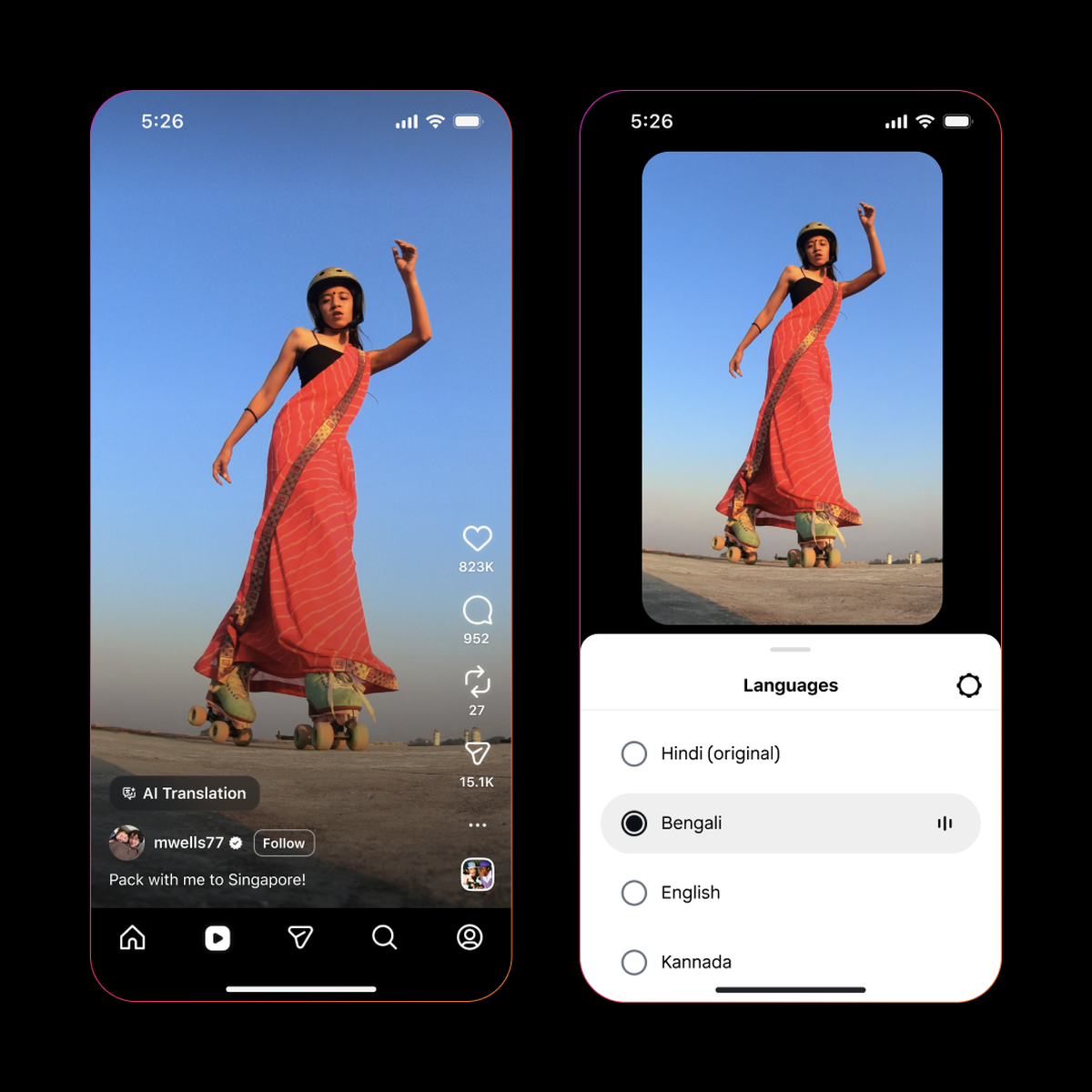
Instagram has rolled out AI-powered Reel translation in five more Indian languages, enabling voice-preserved dubbing and optional lip-syncing. The update boosts content accessibility, supports regional creators, and expands audience reach across India’s diverse linguistic landscape.


The Reel translation by AI announced in Instagram in five other Indian languages is a major step in the history of the service, both as part of the Indian population embracing the digital age and the increased pace at which AI is used in content creation. Translating to Bengali, Tamil, Telugu, Kannada, and Marathi (along with the previous support of Hindi and English) means that Instagram is placing itself at the crossroads of accessibility, creator empowerment, and technological experimentation. However, with the implementation of the feature, the weaknesses and ethical issues of AI-based language technologies become more visible, too.
From Experiment to Expansion: How the Feature Took Shape
The translation history of Instagram was initiated with a small number of world languages, where it concentrated on English, Spanish, Portuguese, and Hindi. India became a priority market with due time because of huge user base and linguistic variety. The most recent release is a strategic shift with experimentation to scale, which focuses on the most popular regional languages in India.
The main centre of the feature is Meta AI which takes advantage of sophisticated speech recognition and neural machine translation and voice synthesis algorithms. When one of the creators uploads a Reel, the system examines the voice on the audio, isolates the voice and background noises, and translates the audio to an option of languages. The AI does not alter the original voice tone, pitch, and cadence of the emotion of the creator, which is in contrast with the traditional dubbing, and makes the translated version sound human, not robotic. There is an optional feature of lip-synch so that the audio that is translated is in sync with the movements of the mouths and the experience is more natural to the viewers.
In the case of creators, the tool can be activated prior to publication, which offers previews and approvals. The audience is presented with a noticeable label Translated with Meta AI and still have the possibility to switch to different languages or revert to the original sound. Such an openness is an indication of a reserved attitude towards the introduction of AI, the strike between innovation and user trust.
Empowering India’s Creator Economy and Digital Inclusion
The move to Indian languages is in line with the Indian digital expansion storey. Most new internet users in the country like to access the contents in their own languages, especially in Tier-2 and Tier-3 cities. Instagram reduces the barrier of languages that once hindered the discovery of content in different regions by facilitating smooth translation and dubbing.
To the creators of regional languages, the influence may be revolutionary. AI translation enables a creator in Tamil Nadu to distribute his creations to audiences in Bengal or Maharashtra without creating a copy of the same Reel. This affordable scaling reinvent the creator economy and allows more audiences to be reached, as well as to engage more and even create new ways to monetize. The preservation of the authentic voice and optional lip-syncing also make sure that the creators are not left without their own identity in the process of translation which is essential to trust and relate to.
The feature is democratising content consumption, in terms of accessibility. The users are also able to interact with educational, cultural and entertainment information in their native language where understanding and interaction are better. In the long term, it would contribute to moving the digital environment in India more towards the state of being not merely English- and Hindi-centric but the one that is genuinely multi-lingual, as the linguistic reality of India suggests.
The Other Side of Innovation: Limits, Ethics, and Cultural Nuance
Nevertheless, the implementation of AI translation on Instagram, notwithstanding its potential, also underscores the nature of the constraints of artificial intelligence with regards to managing language diversity. India has many dialects and idiomatic expressions that are hard to understand by AI models since many of the languages existing in the region are full of cultural allusions. Direct translation of metaphors or jokes can also lead to grammatically correct but culturally inappropriate or incorrect translations.
Moral issues make the situation more complicated. The AI models that are trained on big datasets are likely to inherit the biases of the training data that they train on, potentially encouraging stereotypes or presenting incorrect views of communities. Cultural homogenization is also a possibility, in which subtle linguistic forms get homogenised into normal forms, and over time the local identity is lost.
Another concern area is the issue of data privacy. Given that AI translation is a user-generated process on cloud-based systems, the issue of consent, ownership of the data, and abuse is questioned, particularly when it comes to sensitive or personal data. To professional voice artists and translators, the increased use of AI tools may be seen as a threat of devaluation and displacement, which is why human-in-the-loop supervision is needed.
Conclusion: A Step Forward, With Caution
The Reel translation has become an AI-powered tool that aims to translate Instagram into Indian languages, which is an excellent move towards inclusivity, creativity, and globalisation. It demonstrates the power of AI in removing language obstacles and giving voices in different parts of the world. Simultaneously, it also serves as a reminder to users and policymakers that technology on its own is not able to reflect the richness of culture and humanity in all its complexity.
The success of the feature will be determined by the further refinement as it matures, a variety of training data, and open governance. With proper consideration, the AI translation of Instagram can turn out not only a means of properly growing up, but a model of responsible multilingual innovation in the digital age.