
































Government Proposes Umbrella Commission to Overhaul Higher Education Regulation
India proposes a new Viksit Bharat Shiksha Adhishthan Commission to overhaul higher-education regulation by replacing UGC, AICTE, and NCTE with an umbrella body.


The Union government has proposed a major overhaul of India’s higher education regulatory framework through the Viksit Bharat Shiksha Adhishthan (VBSA) Bill, 2025, which is expected to be introduced in the ongoing Winter Session of Parliament. The Bill aims to streamline oversight by replacing the University Grants Commission (UGC), the All India Council for Technical Education (AICTE), and the National Council for Teacher Education (NCTE) with a single umbrella structure.
The Bill establishes a 12-member VBSA Commission that will supervise three specialised bodies
The Regulatory Council (Viniyaman), the Accreditation Council (Gunvatta), and the Standards Council (Manak). Each of these councils may have up to 14 members. Together, they are expected to coordinate academic standards, regulate institutions, and strengthen accreditation processes in line with the principles outlined in the National Education Policy (NEP) 2020.
The proposed framework will apply to Central and State universities, colleges, technical institutions, teacher-training institutes, institutes of national importance, and institutes of eminence. Professional programmes such as medicine, law, nursing, dentistry, and veterinary sciences have been exempted. The Council of Architecture will continue operating as a standards-setting body and will have representation across all three councils.
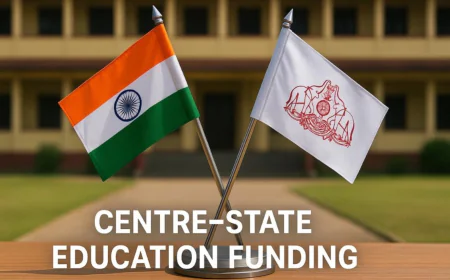
A significant structural shift involves moving the UGC’s grant-disbursal function directly under the Ministry of Education.
The government noted that financial powers should be independent of bodies responsible for academic standards or regulatory enforcement, though details of the new funding mechanism have not been fully outlined.
The Bill also proposes graded penalties, beginning with ₹10 lakh for first-time violations and extending up to ₹75 lakh or institutional closure in cases of repeated non-compliance. Operating without accreditation may attract penalties exceeding ₹2 crore.
The government argues that consolidating multiple regulators will reduce administrative overlap and create a more coherent system. Critics, however, have previously raised concerns over centralised control and reduced autonomy in earlier versions of similar proposals.