






































Ancient Vision: How a Massive Maya Site Reveals Their Early Concept of the Universe
A recently re-examined prehistoric site in southern Mexico — Aguada Fénix — appears not just as a settlement but as a cosmogram: a giant, symbolic map of the universe created by early Maya people around 3,000 years ago. The discovery reshapes our understanding of how ancient societies conceptualised space, water, time and community.

Discovery Beneath the Jungle: The Hidden Monument
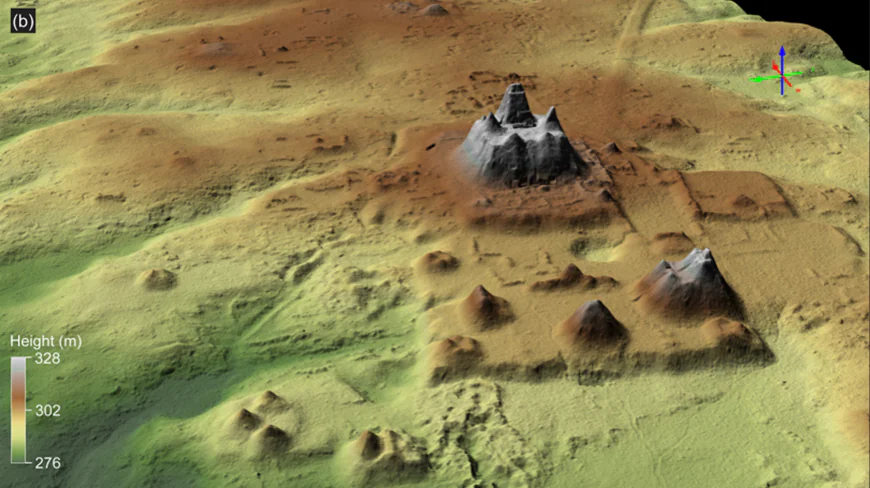
Tucked away in the dense jungles of Tabasco, Mexico, Aguada Fénix was known to archaeologists since 2020 but only recently revealed its true significance. What looked like a flattened mound and earthworks turned out to be the oldest and largest monumental structure attributed to early Maya civilisation.
Spanning roughly a mile in length and built of earth and clay, this structure dates from approximately 1050 BCE to 700 BCE — long before the Maya developed writing or built their famed stone pyramids.
Using modern remote-sensing technology (LiDAR), archaeologists uncovered causeways, dams, and canals interlaced across the landscape — all pointing to a design far more ambitious than a simple settlement.
A Giant Map of the Cosmos: Cosmogram of the Maya
New findings, published in Science Advances, indicate that Aguada Fénix was designed as a “cosmogram” — a symbolic, spatial representation of how the Maya perceived the universe.
Central to this interpretation is a cross-shaped pit (or “cruciform”) discovered within the site. This design, along with colour-coded pigments mapped to the four cardinal directions — blue for north, ochre for south, green for east, and seashell-white for west — suggests the builders were encoding cosmic directions into the very earth beneath their feet.
Additionally, canals and waterworks likely symbolised the importance of water — both as a practical resource and as a sacred element linked to life and the cycle of celestial phenomena.
With a total earth volume rivaling even ancient pyramids, Aguada Fénix was no simple village — it was a carefully composed vision of the cosmos as the early Maya saw it.
Community over Hierarchy: A Different Kind of Civilization
What makes Aguada Fénix particularly striking is the absence of structures typical of hierarchical societies — no palaces, no tombs, no elite burial chambers. This suggests the monument was built not by a ruling class but by a broad community coming together for shared beliefs and rituals.
Some archaeologists estimate that over 1,000 people may have dedicated years collectively to shape the landscape into this cosmic blueprint.
The site’s jade offerings — including carvings of animals, and perhaps even a figurine of a woman giving birth — points to a worldview that celebrated life, nature, and cosmic balance rather than the glorification of kings or elites.
Why This Matters: Rewriting the Ancient Story
The revelation of Aguada Fénix as a cosmogram challenges long-held assumptions about how early civilizations organised themselves. Instead of top-down authority, we see a community united by shared spirituality, cosmology, and collective labour.
This discovery expands our understanding of the Maya — not just as builders of temples and cities, but as thinkers deeply connected to the cosmos, water, life, and the rhythms of the earth and sky. As research continues, Aguada Fénix promises to teach us much more about the roots of human curiosity, cooperation and cosmic imagination.