

































Kaam Maango Abhiyan: When Rural India Rises To Demand Work, Dignity, And Survival
The rural India steps into the spotlight, demanding not charity but guaranteed work. As Kaam Maango Abhiyan unfolds, the clash between policy promises and village realities becomes impossible to ignore.

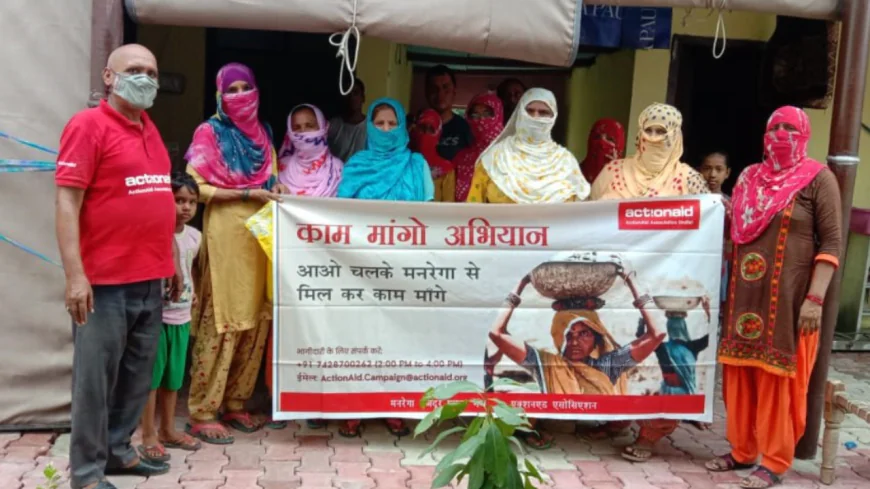
The struggle on the rural employment had again shifted not only out of the corridors of Parliament to the vineyards of India. The core of this confrontation lies in the Congress party campaign known as the Kaam Maango Abhiyan, and this is being marketed not as just a protest, but as a struggle to win the life of what the party terms as a constitutional promise, the right to work. The stakes are also high in emotions and higher in politics; and in the middle of this developing storey, lie the millions of rural livelihoods.
Kaam Maango Abhiyan As Political Strategy And Rural Signal
The Kaam Maango Abhiyan does not represent symbolic sloganeering. It is operational and ground-level mobilisation. The Congress is working on the MGNREGA Bachao Sangram, which is requesting the rural workers to take steps to secure employment under the recently passed Viksit Bharat Guarantee Rozgar and Ajeevika Mission, 2025, law. The purpose is incisive and aggressive: make the new law exert its infirmities in the present time. The party is trying to prove that the new Act is undermining the legal certainty that used to be assured by MGNREGA by assisting the villagers in submitting work applications and claims of unemployment allowances. Critics say that this is political opportunism but proponents say that democracy requires opposition whenever there are redesigned rights without approval. Jairam Ramesh, party general secretary in charge of communications, claims the Kaam Maango Abhiyan would cover 2.5 lakh gram panchayats and crores of people all over the nation. In a short article on X he accused the government of, quote, having bulldozed over MGNREGA, the life-blood of crores of Indians. He defined this as a national fight to reinstate constitutional rights to work, timely pay and accountability and encouraged citizens to participate in the campaign.

Campaign Targets 2.5 Lakh Panchayats Nationwide
Nationwide Panchayat Mobilisation Tests Strength Of New Law
This is a campaign that is being conducted in all gramme panchayats and district headquarters, a magnitude that spells seriousness. Congress workers are conducting mass contact programmes, door to door meetings, and chaupal between January 12 and January 29, 2026. The wider movement will last until the year 25 of 2026, which will guarantee long-term pressure. The organisers Mallikarjun Kharge, Rahul Gandhi, Jairam Ramesh, K.C. Venugopal and convenor Ajay Maken are taking a gamble that the administrative bottlenecks will be seen when millions of people demand work at the same time. In case of the absence of employment within 15 days, Congress cadres intervene to assist in filing unemployment allowance claims, transforming the delay of the procedure into political testimony.
Congress Frames Employment Law Change As Rights Erosion
The Congress storey is clear: they claim that the VB G-RAM-G Act undermines the right to work, puts a financial strain on states and diminishes accountability. According to the party, the new framework threatens to slow down wages, water down entitlements as well as weaken local administrations. Instead, the government is demanding that the law should modernise the rural employment and balance it with development objectives. However, on the streets, ideology is not much when the pay is late and the work is missing. Such a campaign is intentionally designed to reveal such disjunction between the promise of legislation and its reality. With this movement becoming more and more intense, it is no longer about who wins the political argument, but rather, who bears the social cost. When work is refused, the campaign becomes morally compelling, when it is granted, the law is subjected to the initial test of strength. In any case, Kaam Maango Abhiyan has rewritten rural employment policy as popular challenge- India villages are waiting, waiting and demanding.
Yet, on top of all this going and coming, it is not speeches or statutes that can prove whether an employment law is sound or unsound, rather it is cold numbers--how soon work is turned out and how soon the rights of an employment claimant are fulfilled, as also how long it takes the wages to get to the hands of a worker.
Under MGNREGA, the law guaranteed employment in 15 days and on paper, there were good results as compliance rates reached up to 99.68 percent by March 2022. Not so, however, according to independent verifications in several states: hardly 32 percent of wage payments were made on time as required. That is, paperwork was done quickly but so was not livelihood. The same trend is observed when we look at 100 days of work. Approximately 71.9 lakh households, or close to 10 percent, were in the full entitlement, a record year by 202021 due to the pandemic. This fell to 59.2 lakh (7.6%) by 2021-2022 and about 40.7 lakh households in 2024-2025, which is less than 8 per cent of the total in the country. In spite of the fact that the right was on paper, full access was the exception.
Next is VB-G RAM G, which is planned to be used at the end of December 2025 with a promise of 125 days of work, subsidies to maintain the wages weekly and use technology to oversee it. However, as of early 2026, no annual data is available, as well as no information on the work being done in 15 days, no number of households being able to do 125 days, and no confirmed wage-delay results. The only thing we know is the inheritance: in 2024-2025 the unpaid wages under MGNREGA alone were 974.38 crore.
Consider it in this manner--MGNREGA was a bridge on which the cracks appeared, though it existed. VB-G RAM G will offer a stronger bridge yet until workers cross it, numbers not guarantees will decide whether it will be found to hold.
In the case of Kaam Maango Abhiyan, it ceases to be an ideological question because it is now an elemental question. Will job guarantees turn into fast employment and salaries, or be stuck in data dashboards? In the case of rural India, dignity is not discussed, it is enforced, one labour day at a time.