
































Rising Against the Odds: India Emerges as the World’s Most Trusted Growth Engine, Says IMF
From a historic pandemic contraction to becoming the IMF’s key global growth engine, India’s economy showcases resilience through fiscal stimulus, structural reforms, manufacturing push, and digital transformation, while navigating inflation risks, employment challenges, and long-term sustainability concerns.

From the depths of a historic contraction to becoming one of the world’s most reliable growth anchors, India’s economic journey between FY2020–21 and FY2025–26 reflects a calibrated policy response shaped by crisis management, structural reform, and long-term institution-building. The International Monetary Fund (IMF) now consistently identifies India as a major engine of global growth, even as it flags persistent structural and execution-related challenges. This change has occurred in separate periods- each characterised by novel policy, political options, and trade-offs at the macroeconomic levels.
Crisis Management and Policy Reset (FY2020–21)
India’s economy contracted by –7.3% in FY2020–21, the sharpest decline in independent India’s history, triggered by the COVID-19 pandemic and a nationwide lockdown. The decline in GDP was an unprecedented 23.9 percent in Q1, which required a complete reset of the macroeconomic policy framework. The government temporarily stepped away from fiscal orthodoxy under the Fiscal Responsibility and Budget Management (FRBM) Act, allowing the fiscal deficit to widen to 9.3% of GDP to prevent a deeper economic collapse.
The invocation of the Disaster Management Act, 2005 provided the legal backbone for centralised decision-making, enabling uniform lockdowns, coordinated health responses, and the mobilisation of disaster funds. Although this guaranteed administrative coherence and containment of the virus, it also revealed its limitations, most notably the humanitarian pressure of migrant workers and informal-sector jobs that revealed the lack of social protection of urban residents.
Parallelly, the Atmanirbhar Bharat Abhiyan, valued at nearly ₹20 lakh crore (around 10% of GDP), shifted policy emphasis toward liquidity support and supply-side resilience rather than immediate demand stimulus. Measures such as ₹3 lakh crore in emergency credit guarantees for MSMEs and expanded food security under the Pradhan Mantri Garib Kalyan Anna Yojana stabilised employment and consumption at the bottom of the pyramid. Critics however observed that a large portion of the package was based on credit guarantees instead of direct fiscal spending which could not generate demand on a short term basis.

Recovery Through Investment and Stability (FY2021–22 to FY2023–24)
It was possible to achieve a sharp turn around because of the policy ground work that was done during the crisis phase. India recorded 9.1% GDP growth in FY2021–22, among the fastest globally, driven by strong public investment and accommodative monetary policy. Union Budget 2021–22 marked a decisive pivot toward capital expenditure, allocating ₹5.54 lakh crore to infrastructure, while the Reserve Bank of India, operating under the RBI Act, 1934, maintained low interest rates and ample liquidity to revive credit demand.
This recovery phase was tested in FY2022–23, when the Russia–Ukraine war triggered global commodity price shocks. However, India expanded by around 7.2 percent, which was helped by interventionist policies. Fuel excise duty cuts cushioned inflationary pressures, the Essential Commodities Act was used to curb hoarding, and food subsidies under the National Food Security Act, 2013 protected vulnerable households’ purchasing power. These measures preserved macroeconomic stability, though at the cost of elevated subsidy bills and pressure on fiscal consolidation.
Momentum strengthened further in FY2023–24, with GDP growth estimated at 8.2%. The capital expenditure went past 10 lakh crore and supported infrastructure-based growth under the FRBM framework. The tax buoyancy and compliance were improved through structural reforms like the Goods and Services Tax (101st Constitutional Amendment Act) allowing the government to make sustained investments in the economy without interrupting the debt figures. IMF termed this stage as quality growth though it also warned against the disparate investment by the private sector and the intensity of employment.
Manufacturing Push and Future Outlook (FY2024–25 to FY2025–26)
Looking ahead, the IMF projects India to grow at 6.7–7% in FY2024–25, contributing nearly 15–18% of global growth, and around 6.6% in FY2025–26. Central to this optimism is India’s manufacturing-led strategy anchored in Production Linked Incentive (PLI) schemes, aligned with the Make in India framework. These schemes cover 14 thriving sectors and have resulted in faster investment, export growth, and diversification of supply-chain that has made India a realistic substitute in a disjointed global trade system. This direction is to be anchored with long-term reforms. The National Infrastructure Pipeline, Digital Public Infrastructure (DPI) backed by the IT Act, 2000, and consolidation of labour laws into four Labour Codes aim to improve productivity, formal employment, and institutional efficiency. The IMF perceives these reforms to be very essential in maintaining growth and protecting India against external shocks.
Yet limitations remain. Lags in implementation, the inequity in the adoption of labour reforms at state level and the difficulty in creating mass employment highlight the dangers of over-reliance on capital-intensive growth. The IMF has reiterated that India will rely on the macro strength to translate it into inclusive results as the growth dividend.
India’s emergence as a major global growth engine is not the result of a single policy, but a sequence of adaptive responses—crisis management, investment-led recovery, and structural transformation. The fact that the IMF evaluation points out confidence in the ability of India to withstand the turmoil as well as apprehension of incomplete reforms and projects. With the world economy in unstable times, the Indian experience points to an even greater lesson: long-term leadership in global development must be not only about size, but also about moderation between goals, actions, and inclusion.
IMF View: India as a Pillar of Global Growth
It is observed that the International Monetary Fund (IMF) has reaffirmed India’s position as a major growth engine for the global economy, underscoring the country’s growing macroeconomic significance at a time of heightened global uncertainty. The IMF observed that the economy of India performed better than expected in the third quarter, which demonstrates its success and the capacity to withstand the impact of the pandemic. Julie Kozack, Director of the IMF Business Communications Department, shows that the growth momentum in India has been strong and broad based and domestic consumption has become the engine of growth.
The IMF has maintained its growth projection of 6.6% for India in the FY2025–26, but Kozack indicated that the better-than-anticipated recent data increases the likelihood of an upward revision. This revision would also justify the policy-driven revival road in India, which is based on the principle of state investment, promotion of manufacturing, and the digital and institutional change. The IMF reassured that new growth forecasts will be available in the next update of the World Economic Outlook (WEO), which will be issued next week, a major event under the observation of world investors and policymakers.
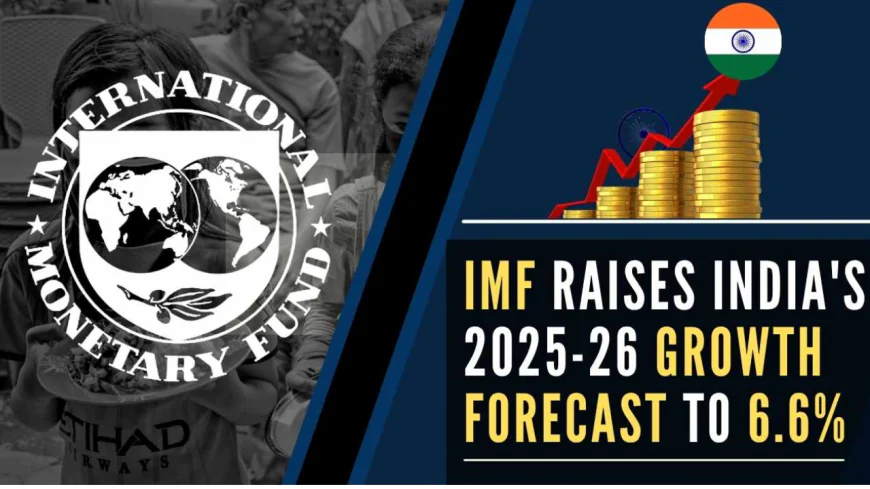 In general, the IMF analysis indicates long-term optimism over the Indian economic fundamentals and policy environment. The Fund recognised global counter-winds and geopolitical risks but at the same time demonstrated the essential role of India in stabilisation of global growth and so the country is not just a high-growth economy but a systemically significant contributor to global economic momentum in an ever-increasing volatile world.