




















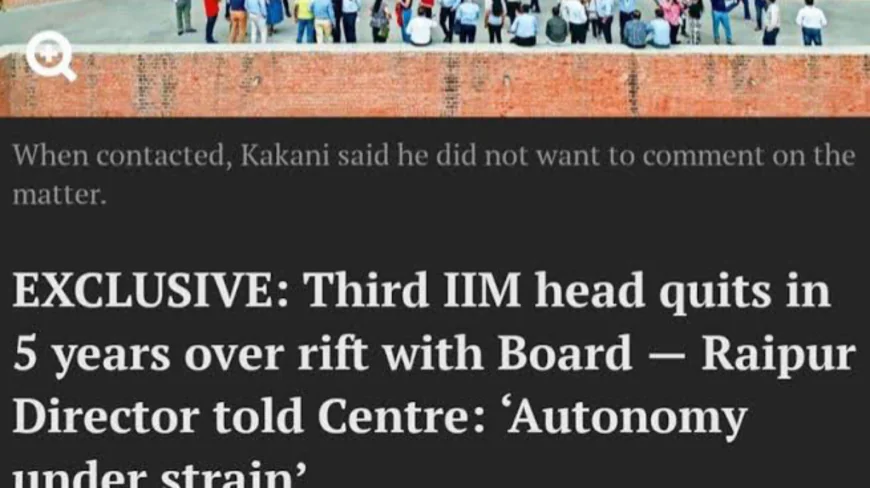
Third IIM head quits in 5 years over rift with Board — Raipur Director told Centre: ‘Autonomy under strain’
Ram Kumar Kakani, Director of IIM Raipur, resigned in July 2025 citing serious differences with the Board of Governors. He says recent court rulings and board actions have weakened his ability to act as director under the IIM Act, 2017. His exit marks the third time in five years an IIM head has quit over similar disputes around governance and autonomy. The episode raises critical questions about how much freedom IIM directors truly possess when functioning under increasingly strong board and statutory oversight.

Autonomy vs Authority: What Sparked the Rift
The trigger was a disciplinary action against a faculty member, who was suspended over allegations of academic impropriety. But the Chhattisgarh High Court struck down the proceedings, on the basis that under IIM Act, 2017, the Board, not the Director, is the appointing and disciplinary authority in certain instances. Kakani claims this verdict shifted a broad range of powers away from him and gave the Board or its Chairperson the ability to exercise control in matters previously under the Director’s executive domain.
The Constriction of “Professional Space”
Kakani, who joined IIM Raipur in 2022, wrote to the Ministry of Education multiple times before resigning. Among his concerns:
• The Board (led by the Chairperson) was increasingly making decisions on disciplinary, financial, and administrative issues without Director’s effective input.
• HR policies in force pre-2017 were being treated as binding, even when they may conflict with the mandates of the 2017 IIM Act.
• Recent events, especially court rulings quashing suspension orders, undermined his ability to manage faculty discipline and institute governance in ways he believed consistent with law and standard practice.
Pattern in the Premier Institutes
Kakani’s resignation isn’t an isolated case. In the past five years, two directors of IIM Calcutta also stepped down due to board-chair conflicts: Anju Seth in 2021 and Uttam Kumar Sarkar in 2023. Both pointed to interference with executive powers, lack of clarity, turf wars with the Board, or “breakdowns of confidence.”
Why This Matters for the IIM System
IIMs are globally respected. Much of that reputation depends on agility, merit-based decision making, faculty freedom, and the ability of leadership to innovate. When power tussles reduce a director’s ability to lead effectively, delays and confusion follow — in recruitment, mentoring, research, infrastructure projects. Kakani believed that some of his initiatives were being stalled or second-guessed not for their merit but due to governance ambiguity.
Looking Ahead: Governance, Clarity, Reform
For IIMs to function as intended under the IIM Act, 2017, there needs to be clearer delineation:
• Which powers lie with the Board vs the Director.
• How pre‐2017 HR and administrative policies interact with the IIM Act’s requirements.
• What procedural safeguards there are when courts override disciplinary actions, in terms of preserving institutional governance.
Unless these questions are addressed, more leadership upheavals are likely, and the autonomy that made IIMs unique may face gradual erosion.